Why You Should Keep One
Everyone selling you an AI tool tells you to check its work. Nobody tells you what checking looks like. It gets said the way "eat well" gets said. Agreed in principle, impossible to act on, and quietly ignored by almost everyone.
Here is the most useful solution I have found. It is not a tool and it costs nothing. Keep a running note of the times your AI nearly got you.
What actually goes in it
Not every wobble. If you write down every time a tool phrases something oddly you will have forty entries by Thursday and you will stop by Friday. The entries worth keeping are the ones where something was about to leave your hands with a mistake in it, and you caught it. That is the whole filter — nearly went out, did not.
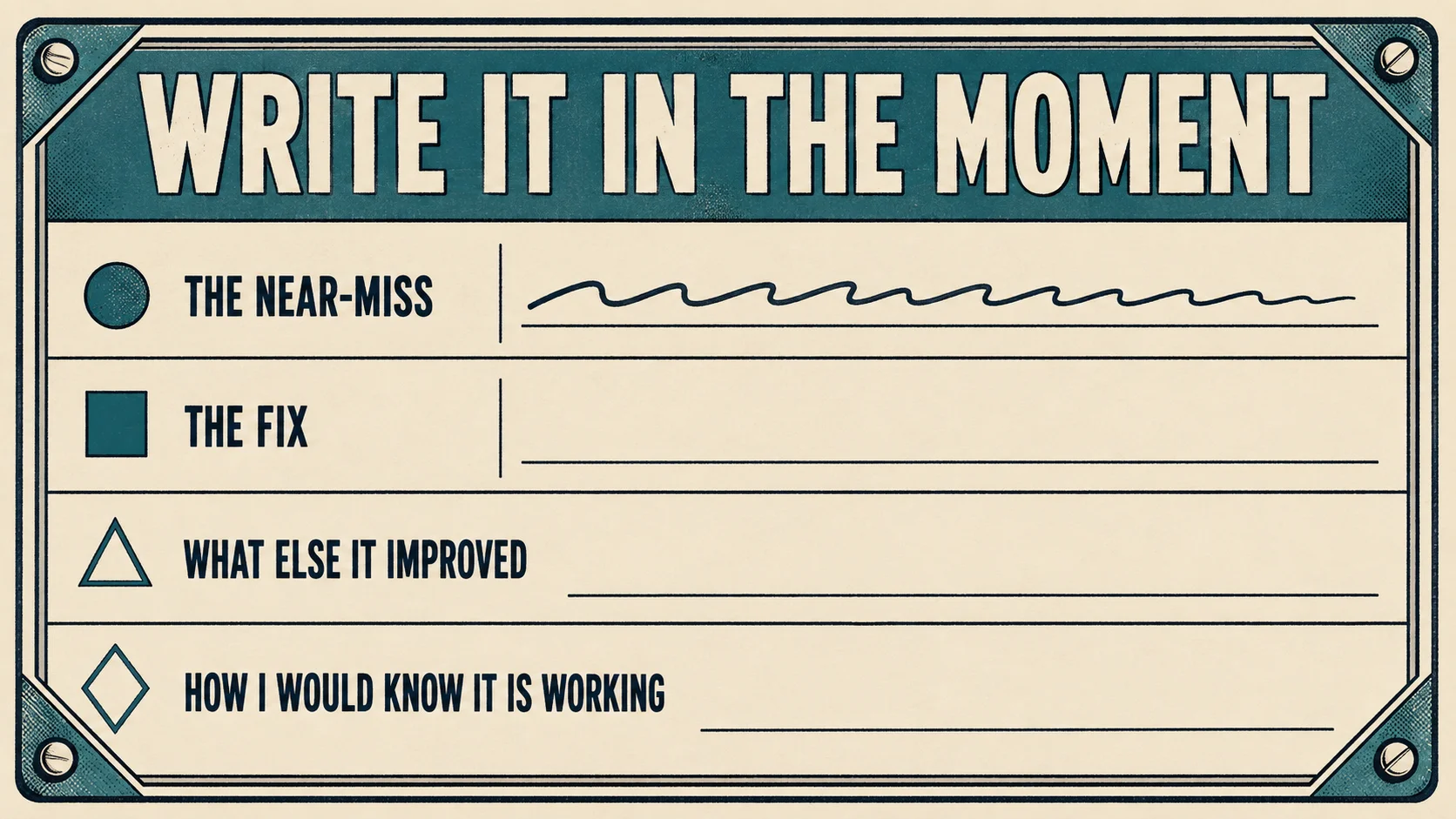
For each one I write four short things:
- The near-miss. What almost happened, in one sentence.
- The fix. The change I made so it does not happen again.
- What else it improved. This is the important one, and I will come back to it.
- How I would know it is working.
That is it. Most entries take two minutes. Some take thirty seconds.
Write it at the moment, not later
This is the part that decides whether the whole thing works. Capture it when it happens. Not at the end of the week, not by scrolling back through your chat history looking for interesting moments.
I learned this from trying the other way. Going back through a transcript, you can see what went wrong. What you cannot recover is why you nearly believed it. The reasoning that made the error plausible is the first thing that disappears, and it is the only part with any value. Two days later all you have is "the tool got the date wrong," which teaches you nothing — and you already knew it.
The near-miss is not the asset. The reason you almost missed it is the asset.
The test that keeps the list short
Most habits fail one particular test, and it is worth being strict about it. Does the fix pay in both directions? A good one catches an error and makes the ordinary case better, on days when nothing goes wrong at all.
One of mine was to open every page on my own site that a draft links to, before finalizing it. It stopped a false claim. It also handed me real specifics I would not have written from memory, which improved a piece where nothing was wrong.
That is the difference between a fix and a chore. A chore only earns its keep on bad days, so you drop it during a busy week and never pick it back up. A fix that pays on ordinary days survives, because you feel it working.
If you cannot say what a habit gives you on a good day, it will not last the month. Do not bother logging it.
Why this matters more with AI tools?
A conventional mistake usually looks like a mistake. Something crashes, or the sentence is visibly garbled, or the number is plainly absurd. These do not. The output is fluent, confident, well-formed and wrong. The one that got closest to me was a sentence that read perfectly and contradicted my own website. Every automatic check I had passed it, because the checks could only see the words in front of them.
That is the actual risk with these tools, and it is not the one people worry about. It is not that the AI produces obvious nonsense you would catch anyway. It is that it produces plausible work, and plausible work does not trigger the instinct that saves you.
A log is how you find the shape of your own blind spots, because it is the only record that keeps the near-misses next to each other where you can see what they have in common. Mine had a pattern in it I would never have guessed from any single entry.
Start it this afternoon
You do not need an app. A note on your phone is fine. Mine is a plain text file.
Three things to get right:
- One place. Two copies of a log will disagree within a fortnight, and then you will trust neither.
- Write it in the moment. See above. This is the one that matters.
- Keep the bar high enough that the list stays short. A log you dread reading is a log you stop keeping — and a log you stopped keeping teaches you nothing at all.
Give it a month before you judge it. The first few entries will feel like busywork. The value shows up when you have enough of them to sort, and you find out that the thing you keep getting caught by is not what you assumed.
That is the whole method. It is genuinely an afternoon to start and about two minutes an entry after that until it becomes an automated routine to review.
If you get into it and want a second pair of eyes on what your log is telling you, or you would rather not work it out alone, text me at 503-664-0546. Email works too: eog@ernestofgaia.xyz. If you would rather book a free call, my assistant can set one up without you having to write anything longer than a sentence.
#ernestGoesToAI