What the Pattern Says
Once I had a handful of entries in my cheap-fix log, I did the obvious thing and sorted them.
I was expecting the interesting finding to be about the AI itself. Something like it is bad at this particular kind of task. That is the story everyone tells about these tools, and it is the story I assumed my own notes would confirm.
That is not what came out.
Six kinds of things going wrong
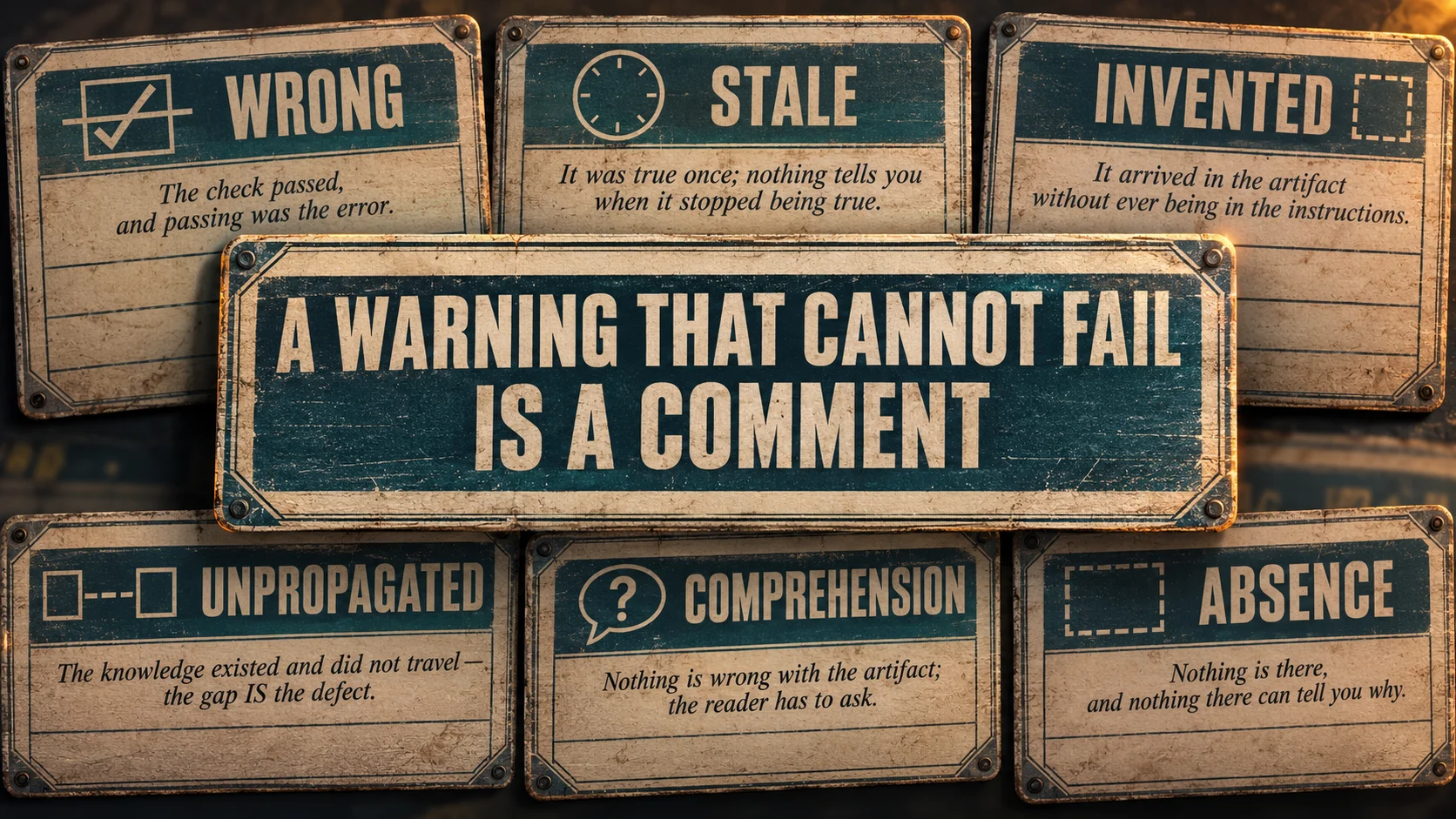
Sorted by what actually failed, the entries fall into six groups.
Wrong. The output states something untrue. A draft contradicts a page it links to. A check reports a pass while testing nothing.
Stale. The output was true once. A cover image rendered before the final edit, still carrying a claim the edit removed.
Invented. Content that appears in the finished thing without ever existing in the instructions. A mark on a shirt nobody asked for.
Unpropagated. Somebody learned something and the rest of the system never found out.
Comprehension. Nothing is wrong with the artifact at all. The sentence is accurate, the instruction is correct, and the reader still has no idea what it means.
Absence. Something is missing, and missing does not tell you whether it was removed on purpose.
Five of those six describe a defect in a thing. You can hold the artifact up against the claim and see the mismatch. The last two cannot be caught that way, which is what makes them expensive.
The one that keeps coming back
Unpropagated is the repeat offender, and it is not close.
Here is what it looks like. I had a video thumbnail that carried some text it should not have. I re-rendered the image from source, correctly, and the wrong picture stayed live on a public video. Re-rendering changes the file on my disk. It does not change the copy the platform is already serving.
That is the shape of the whole class. The knowledge existed. It was correct. It simply did not travel to where the next action would look for it.
The second one is sharper, because it was predicted in writing.
I reorganized a folder. A script had the old location written into it, so the moment the folder moved, part of my publishing path was broken. Silently. Nothing failed loudly — the next thing that needed it would simply not have worked.
Three separate documents had said, in prose, that moving that folder would break working plumbing. They were right. It broke anyway — which is the part worth sitting with.
I have been chewing on why ever since, and the answer is uncomfortably simple. A warning that cannot fail is a comment, not a check. Those three documents were correct and completely inert. They said the right thing to a reader who was not reading them at that moment. The repair was not to write a fourth warning. It was to add the check the warnings had been standing in for, which either exits clean or does not.
The sixth class showed up twice in one sitting
The newest group is the one I called absence, and it arrived with a lesson attached.
Reviewing some scheduled posts, I found three of them carrying no link and no tracking tag. Against the rule I had written, that reads as a violation. I was one keystroke from filing it as a problem.
It was not a problem. It was a deliberate, documented decision, recorded in the channel's own notes and in the filename of the file I was looking at. The platform strips links from those posts, so the links had been removed on purpose.
The check that saves you here costs nothing: before calling a gap a defect, look at the neighboring documents and the filenames for a recorded reason. It either returns something or it does not.
Then the same blind spot caught me again in the same session, and that one got past me. I reported that a series had only reached six posts when all eight existed. My counting method searched one system for a tracking tag. It could not see the post published by hand, which never entered that system, and it could not see the post whose tag had been deleted by the very stripping behavior I was investigating.
The measurement was destroyed by the bug it was measuring — and it looked like a clean number the whole time.
So the rule I took from it is not about counting. It is: when you report a number, say what your method cannot see. The interesting failures were not the AI being stupid; knowledge that existed did not travel, and no linter, test or review catches that class. A log does, because a log is the only artifact that remembers what was learned and when.
Next: what it takes to keep one, and why I think it is worth an afternoon.
#ernestGoesToAI