The Cheap Fix Card
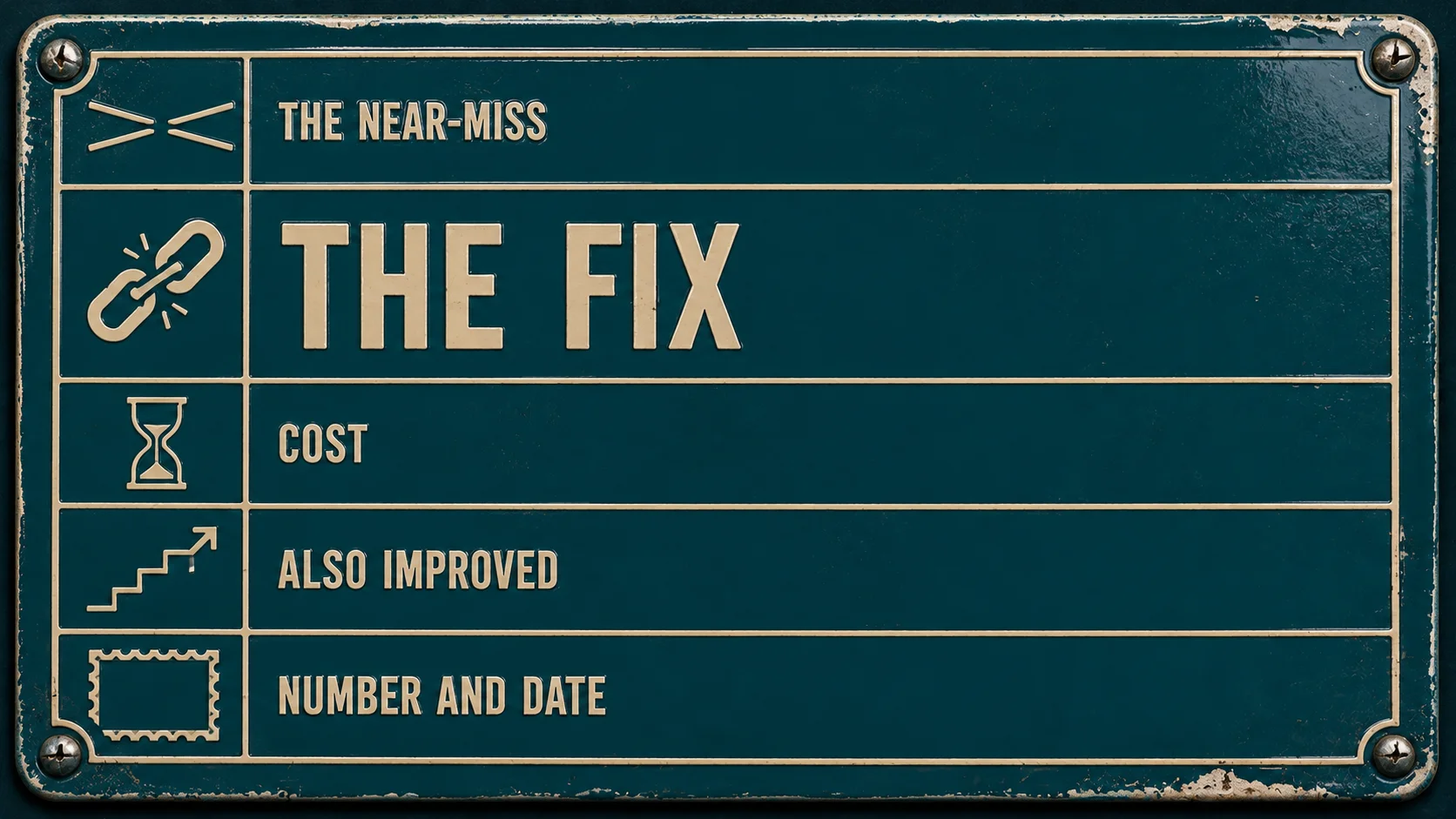
A log you never reread is a diary. That is the problem I ran into about three weeks into keeping one. The entries were good. They were specific, they were earned, and they were sitting in a text file I opened roughly never.
Writing something down is not the same as remembering it — it only feels like it. So this post is about the format I use to turn one entry into something that gets seen again, and about the one rule that decides whether it stays true.
Five slots, always the same five
THE NEAR-MISS. What almost went out, in one line. Not the category, the actual thing.
THE FIX. In the largest type on the card. If someone glances at it for one second, this is the part they read.
COST. How long the fix takes, every time. Seconds, or a minute. If this slot is uncomfortable to fill in, the fix is not cheap and probably will not survive contact with a busy week.
ALSO IMPROVED. What it gives you on a day when nothing goes wrong. This is the slot that separates a fix from a chore, and it is the one most people would leave off. It is the reason the habit lasts.
NUMBER AND DATE. Which entry this is, and when it was captured. Dull, and it does more work than it looks like.
Same five, same order, every card — no exceptions, including the ones that feel like exceptions. That constraint is doing the work. When the shape never changes you stop deciding how to write it up and start just writing it up, and a format you do not have to think about is one you will actually use at the end of a tiring day.
Why a card and not a list
I like reminders. That is the honest reason, and I think it generalises further than my own preference.
A text post gets read once. A card gets saved, and then it turns up again later on a day when you were not thinking about it. Being seen a second time is most of the value, because the whole point of a cheap fix is that it has to fire at the right moment months from now, when you are tired and moving fast and not thinking about process at all.
The number and date slot pays off here too. Once there are a dozen of these, the number is how you find one again, and the date is how you know whether it was written before or after some change that might have invalidated it. Both of those matter more at card fifteen than at card two, which is exactly why the slot has to be there from card one.
The rule that keeps them true
Here is the one that took me a while to get right, and it applies to anything you put in a picture.
Keep the perishable specifics off the card.
Tool version numbers. Prices. File paths. Menu locations. The name of the button you click. All of it is true today and some of it is wrong in four months, and the card will still be sitting there saying it with complete confidence.
The rule behind the fix is stable. Check the page you are linking to before you finalise. That will be true for as long as pages and links exist. The specific way you check it will change, and that part belongs in your notes, not burned into an image. The facts you leave off cannot betray you later. When you are unsure whether something belongs on the card, that hesitation is the answer.
The card is also not the log. The log is the source and it keeps growing; a card is a reading taken from it on a particular day. If those two ever disagree, the log wins — always. A card that has quietly gone stale is worse than no card, because it carries the authority of something that was deliberately made.
That's the whole format
Five slots, no perishable specifics, and the log stays the thing that is true.
If you start keeping one and want to compare notes on what shape works for you, text me at 503-664-0546 or email eog@ernestofgaia.xyz. I am genuinely curious whether the five slots hold up for anyone whose work looks nothing like mine.
#ernestGoesToAI