Nineteen Real Humans in My Server Logs
I pulled four weeks of my own server logs in July, expecting to find out who reads this site.
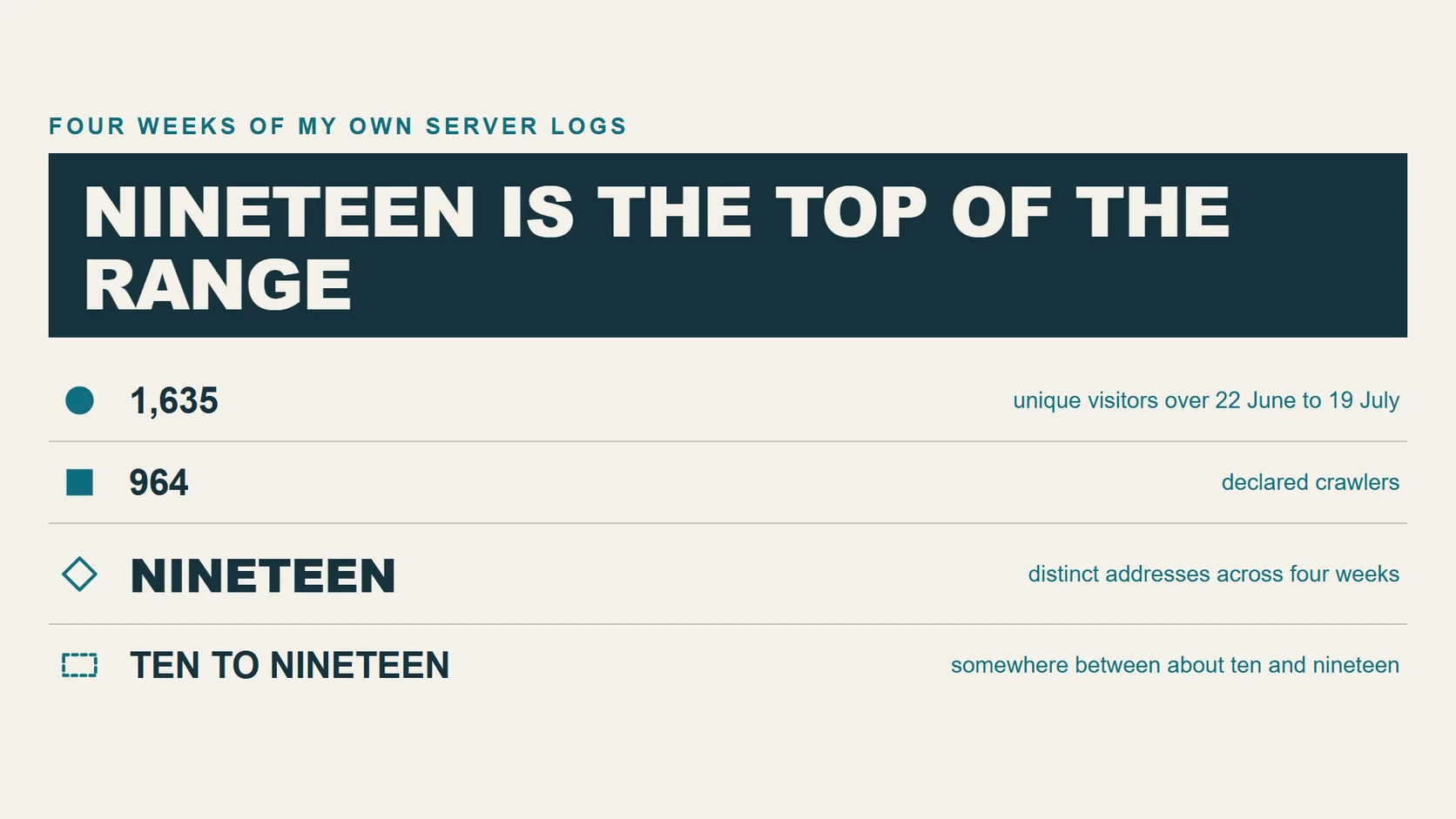
The headline number was 1,635 unique visitors over 22 June to 19 July. That's a real number, produced by real software, and I could have put it on a slide. About fifty-nine percent of it was robots.
What's actually in a server log
Every time anything asks your website for a page, your server writes a line. That line's honest in a way a dashboard isn't. It doesn't decide what counts as a visitor. It just records that something asked.
Some of those somethings are people. A lot of them are crawlers: search engines, AI companies building training sets, SEO tools, security scanners looking for a way in. They announce themselves in the request, so you can count them if you look. You almost certainly have the same file sitting on your own host right now.
When I counted mine, declared crawlers accounted for 964 of those 1,635. That left somewhere around 550 to 600 that might've been human.
Then I looked for Oregon, and found Google
My whole thesis is local. I want to connect with people on the Oregon coast, in the valley, and in Portland. So I filtered for Oregon and got a number that looked genuinely good.
It wasn't. Oregon has three enormous datacenters — The Dalles is Google, Boardman is Amazon, Prineville is Meta and Apple. Their machines resolve as Oregon traffic. If you filter by your own state and celebrate, there's a fair chance you're celebrating a crawler in a shed by a river.
Taking those out left residential and small-town Oregon: Portland, Canby, Carlton, Tigard, Hayesville, Hillsboro. About nineteen distinct addresses across four weeks.
The title of this post is generous, and I want to say so
Nineteen is the top of the range. My own baseline note says roughly ten to nineteen, and I put the bigger one in the title because it's the one that scans.
They're also not nineteen humans. They're nineteen network addresses. If you use a laptop and a phone, you're two of mine. A whole household on one connection is one. And the geography comes from a free city database that's reliable about countries, fair about states, and rough about cities, so a "Portland" hit might be anywhere in the metro.
So the true statement is: somewhere between about ten and nineteen distinct connections that were plausibly local people, over a month, with a wide error bar.
I could've written "nineteen real humans" and left it there. It's a better line. But this whole project is a bet that being trustworthy about small numbers is worth more than sounding bigger, and the first place that gets tested is my own headline.
What I actually took from it
The first is that I now have a starting line. Ten to nineteen is a number I can watch move. You can't tell whether something you tried worked if you never wrote down what it was like before, and most people don't write it down until they've already changed something.
The second is that the security probes were the quiet good news. Automated scanners hit /.env, /.git/config and /wp-login.php, looking for credentials and an old WordPress install. Every one of them got a 404, because there's nothing there to find. I didn't know that for certain until I looked, and you probably don't know it about yours either.
The third is the one I keep coming back to. A raw visitor count and an audience are different things, and nothing in the number tells you which one you're holding. That's not a flaw in the tool. It's what the tool is for — the log records what asked, and deciding what counts is the part you have to do yourself.
Most small business dashboards never make that separation. So the number on your screen is bots and people added together, and it goes up when a crawler discovers you, which feels exactly like growth.
I'd rather have nineteen and know what they are.
If you want a hand finding out what's actually in your own numbers, text me at 503-664-0546 or email eog@ernestofgaia.xyz.
#ernestGoesToAI