Forty Thousand Letters, One Candle
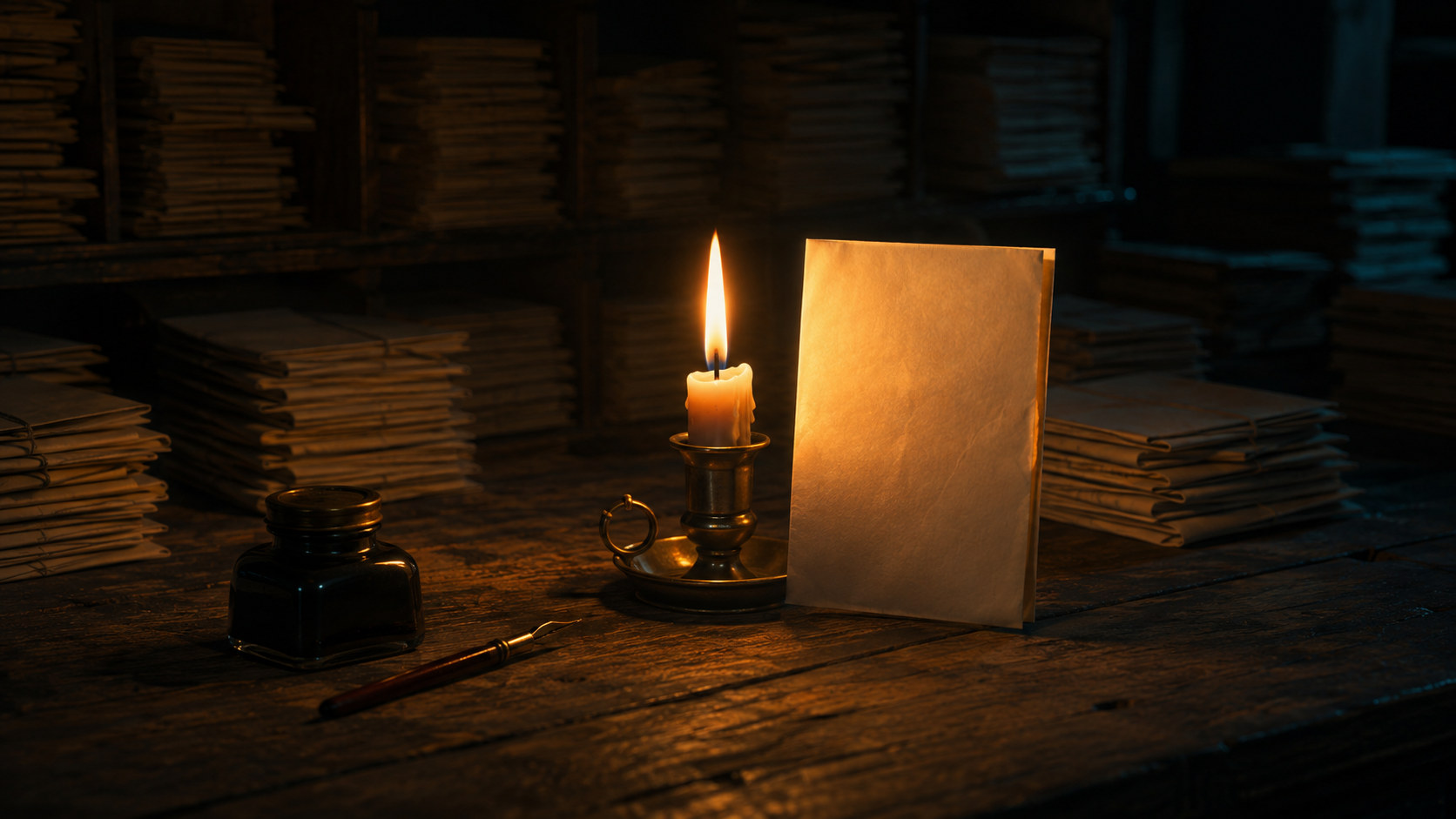
Before 1840, someone in London held the post up to a candle every single night.
Not for light to read it by. The price of a letter depended on how many sheets of paper were folded inside it, and the only way to find out was to hold the folded packet against a flame and look through it. Forty thousand letters were checked this way on a busy night, one at a time.
That was one step of several. The price also depended on how far the letter was travelling, so each one had a rate worked out against the distance and written on the front in pen and ink. Then, before the night was over, nearly seven hundred separate accounts had to be drawn up, one for each deputy postmaster in the country.
None of that moved a letter an inch towards its destination.
The two minutes at the door
In those days the person receiving the letter was the one who paid for it. So the postman knocked, and then stood there.
Two minutes at a house was normal. Sometimes three, four, five, while someone went to find change.
The Post Office measured this on itself, and the measurement survives. In 1828 the Commissioners of Revenue Inquiry examined Benjamin Critchett, Inspector of the Inland Letter Carriers, who walked them through a single morning in the Lombard Street district. Six hundred and thirty-seven letters had gone out.
Five hundred and seventy of them went early, under an arrangement where the money was collected on a second round afterwards. Those took half an hour.
The remaining sixty-seven went the ordinary way, with the money collected at the door. Those took an hour and a half.
Same district, same morning, same streets. The difference was not the walking.
What it actually cost to carry a letter
In 1837 a schoolmaster named Rowland Hill published a pamphlet arguing the whole thing should be torn up. The part of it I keep thinking about is not the proposal. It is the arithmetic that came first.
Hill worked out what the Post Office was really paying to move a letter — mileage charges, guards' wages, tolls, divided across the weight of mail actually on the road. London to Edinburgh, four hundred miles, came out at "not more than one thirty-sixth part of a penny."
A thirty-sixth of a penny. There was no coin small enough to charge it with, which was rather the point.
So the distance was never the expensive part. Here is Hill's own diagnosis, unsoftened:
"the chief sources of all this trouble, and error, and fraud, exist in the complexity of the operations; a complexity arising out of the varying charges for postage"
The Post Office's own staff had said as much, in plainer words. Asked which stage of preparing the letters took longest — the stamping, the sorting, or the accounts — an officer named D. W. Stow answered that it was taking the accounts. The stamping, by that account, "is a mere mechanical thing."
People had already routed around it
This is the part I find hardest to look away from. Long before anyone reformed anything, ordinary people had worked out where the price was coming from and gone around it.
Hill printed one such case in the pamphlet, quoting Coleridge:
"One day, when I had not a shilling which I could spare, I was passing by a cottage not far from Keswick, where a letter-carrier was demanding a shilling for a letter, which the woman of the house appeared unwilling to pay, and at last declined to take. I paid the postage; and when the man was out of sight, she told me that the letter was from her son, who took that means of letting her know that he was well: the letter was not to be paid for. It was then opened, and found to be blank!"
Hill was not telling that story to move anybody. It is filed under fraud, with the note: "This trick is so obvious a one that in all probability it is extensively practised."
The letter arriving was the message. The shilling was for the part nobody needed.
What the reform actually removed
Hill's answer was not a faster horse or a better-drilled clerk. It was one price, everywhere, paid in advance — and what that bought was subtraction. In Hill's own description of the evening after the change:
"There would be no letters to be taxed; no examination of those taxed by others; no accounts to be made out against the Deputy-Post-masters for letters transmitted to them, nor against the Letter Carriers."
The candle goes out. That is the reform.
In 1840 it became law: one penny, prepaid, any distance in the kingdom. And the argument that got it there was never that the post was too slow. It was that the paperwork wrapped around a letter cost more than carrying the letter did.
I ended up in Hill's pamphlet because I was writing the About page for a small 1840s postcard toy I built called The Penny Post, one of the browser apps I've been assembling in my spare time, all about messages on the web. Reading the original turned out to be a different exercise from reading about it.
#ernestGoesToAI